
Page published 27 April 2026
 Introduction
In 2006 I submitted the third article I had written in the hope it would be published in "Norfolk Afloat", a magazine that in later editions became "Anglia Afloat". I was never commissioned to write an article I simply submitted something I hoped would appeal to the editor. I had the advantage that none of the other regular contributors seemed to live in north west Norfolk as I did. The article was accepted and appeared in Issue #21 (July-August 2006). It contains some 1400 words, around a couple of hundred less than I submitted. If you want to read the published version you can Download A Scan If you prefer to read the text that I submitted, and see some of the photos I have that weren't even submitted with the article read on.
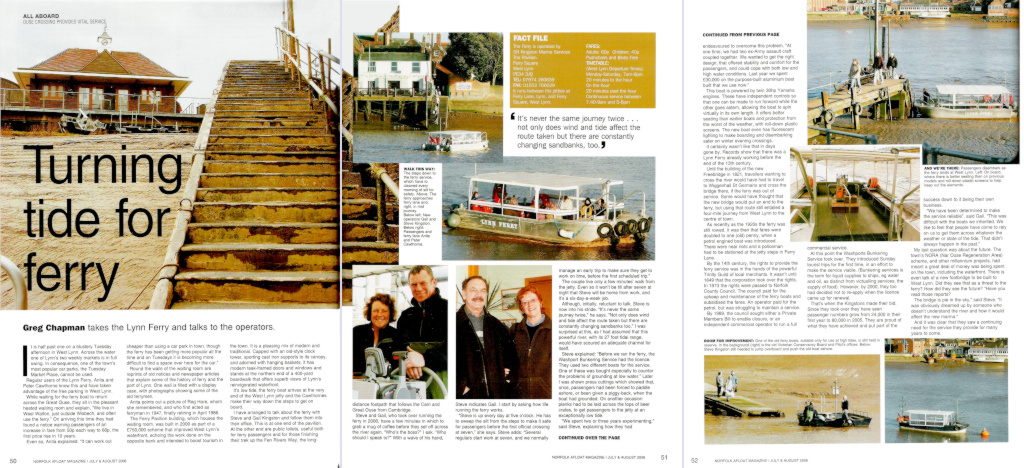
The article as published appeared on pages 50-52 in the July-August 2006 edition of Norfolk Afloat.
I do have a small problem with the pictures. In January 2011 I had a hard disk failure and had to use the services of a data recovery expert to extract as much of the data as possible from the disk. I have only just realised that it appears that it was the damaged area of the disk that held my only copies of the full frame versions of the photographs used for the article. Some image files are missing completely. Others show with the recovery date, while the EXIF data within the file show correct information.
While I may not have the original files I do have the cropped versions of the photographs that I submitted with the article, some of which were taken around 14:00 on Friday 20 January, perhaps the day when I had the idea of approaching the ferry operators for an interview. The others were taken on Tuesday 28 and Wednesday 29 March 2006. I guess that Tuesday was chosen by Steve and Gail Kingston, the ferry operators, as that is likely to be a busy day and that I returned the following day to try to get some better sunny weather photos.
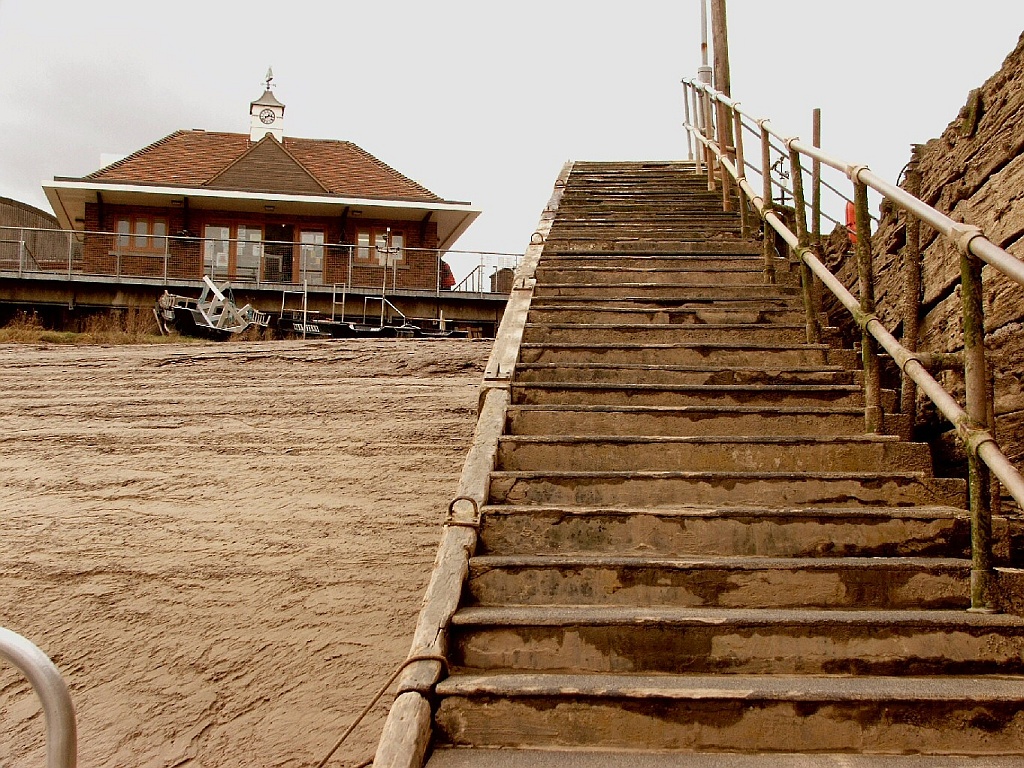
Chosen by the editor as the header image for the article my suggested caption was not used: "With a 27 foot tidal range, it can be a long climb up to the pavilion and over the flood defence walls".
The Text Submitted
It is half past one on a blustery Tuesday afternoon in West Lynn. Across the water one of Lynn's two weekly markets is in full swing. In consequence, one of the town's most popular car parks, the Tuesday Market Place, cannot be used. Regular users of the Lynn Ferry, Anita and Peter Cawthorne know this and have taken advantage of the free parking in West Lynn. Whilst waiting for the ferry boat to return across the Great Ouse, they sit in the pleasant heated waiting room and explain, "We live in West Walton, just outside Wisbech, and often use the ferry." On arriving this time they had found a notice warning passengers of an increase in fare from 50p each way to 60p, the first price rise in ten years. Even so Anita explained, "It can work out cheaper than using a car park in town, though the ferry has been getting more popular all the time and on Tuesdays it is becoming more difficult to find a space over here for the car."
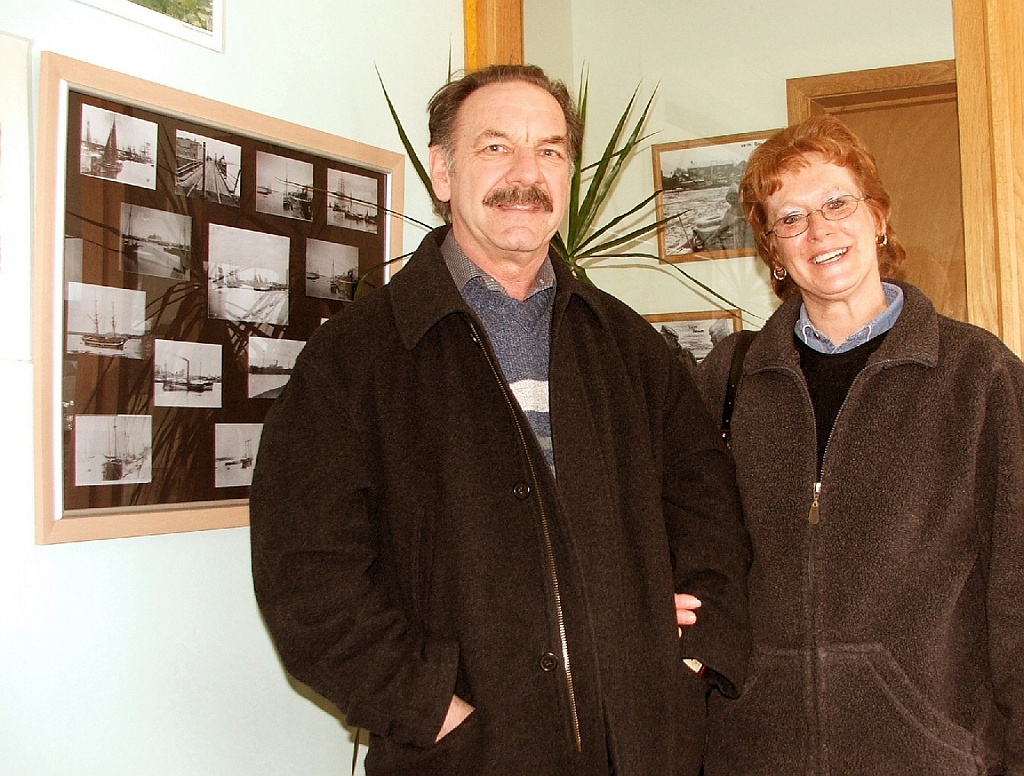
The photograph of the two passengers I encountered in the ferry waiting room that was used in the magazine, but cropped, so you couldn't see some of the photographs referred to in the text.
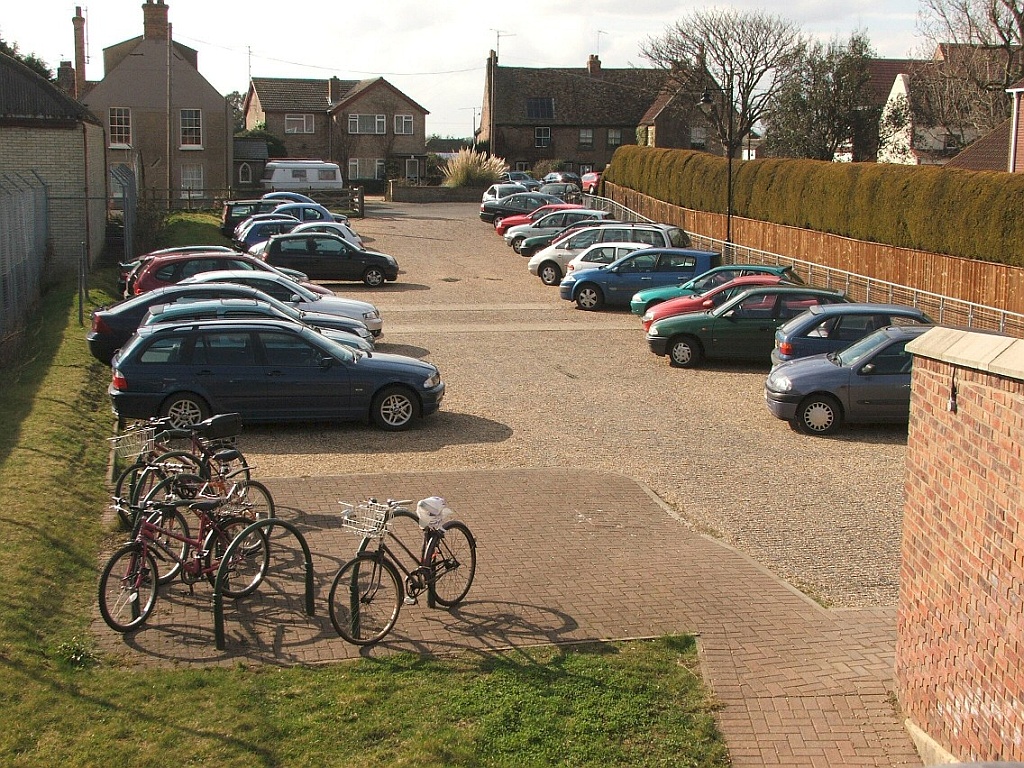
A picture the editors chose not to use but my suggested caption said, "The well used free car park behind the West Lynn Pavilion. A number of commuters to Lynn from Lincolnshire villages use it regularly.
Round the walls of the waiting room are reprints of old notices and newspaper articles that explain some of the history of Ferry and the port of Lynn. One wall is filled with a display case, with photographs showing some of the old ferrymen. Anita points out a picture of Reg Hare, who she remembered, and who first acted as ferryman in 1947, finally retiring in April 1986.
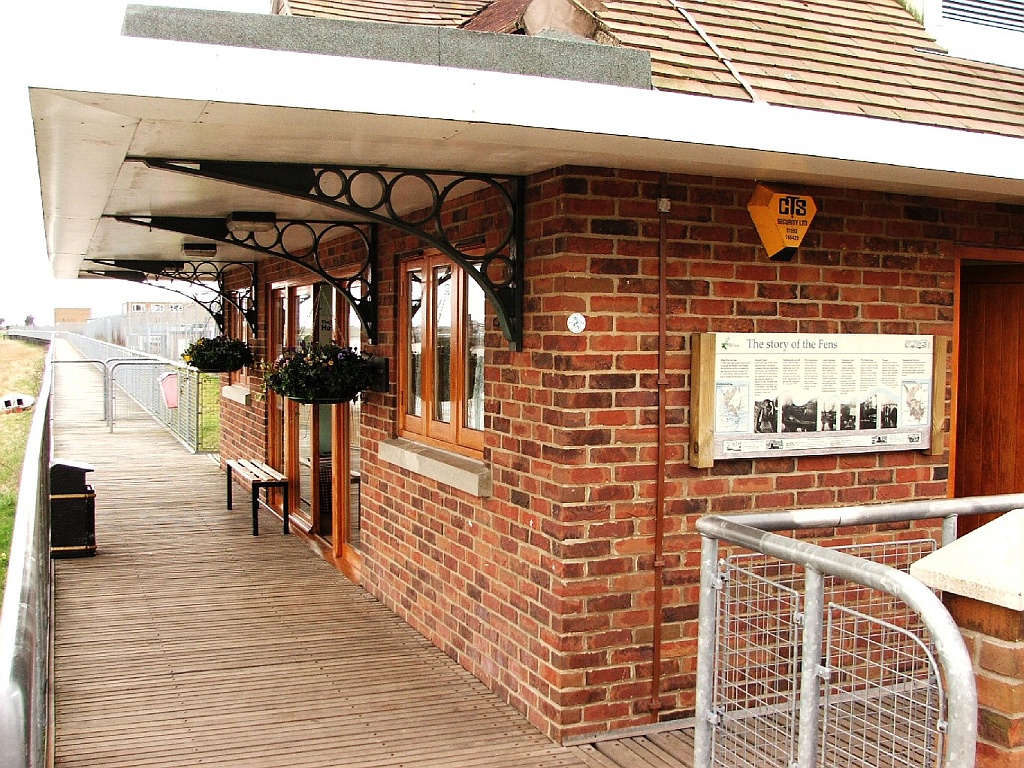
Another photo not used in the magazine for which my suggested caption was: "The front of the Ferry Pavilion at West Lynn, at the northern end of the 400 yard board walk and commanding great views of the Lynn Waterfront"
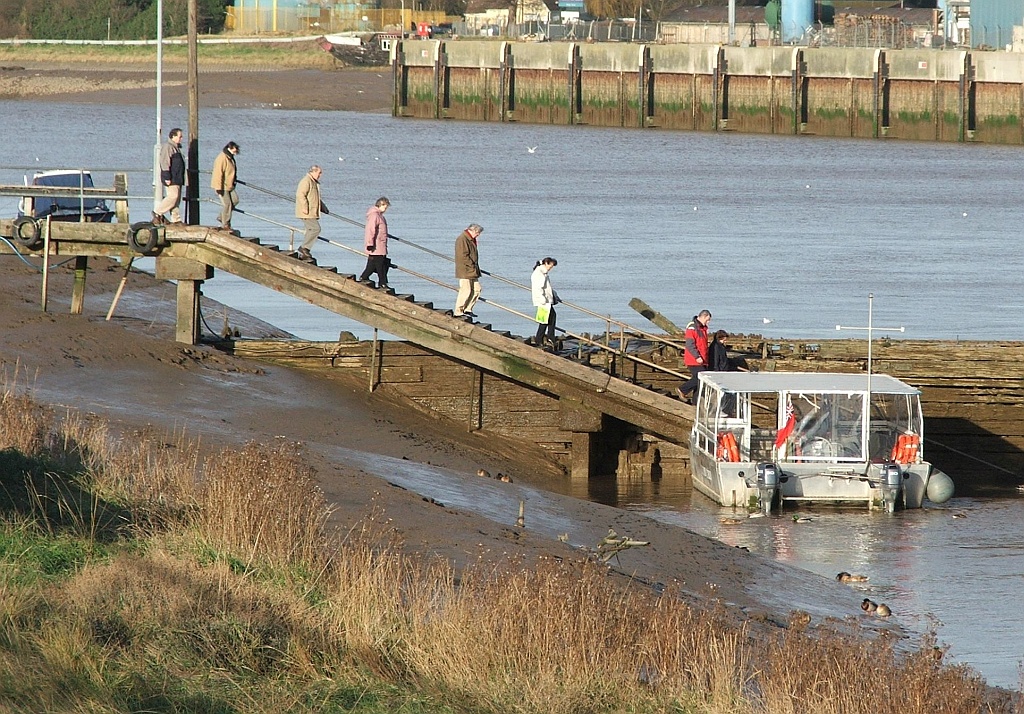
Passengers embark at the West Lynn jetty. Note the barrier that provides an area sheltered from the main current in the river.
The Ferry Pavilion building, which houses the waiting room, was built in 2000 as part of a £750,000 scheme that improved West Lynn's waterfront, echoing the work done on the opposite bank at the same time and intended to boost tourism in the town. It is a pleasing mix of modern and traditional. Capped with a old-style clock tower, sporting cast iron supports to its canopy, and adorned with hanging baskets, it has modern teak-framed doors and windows and stands at the northern end of a 400 yard board walk that offers superb views of Lynn's reinvigorated waterfront.
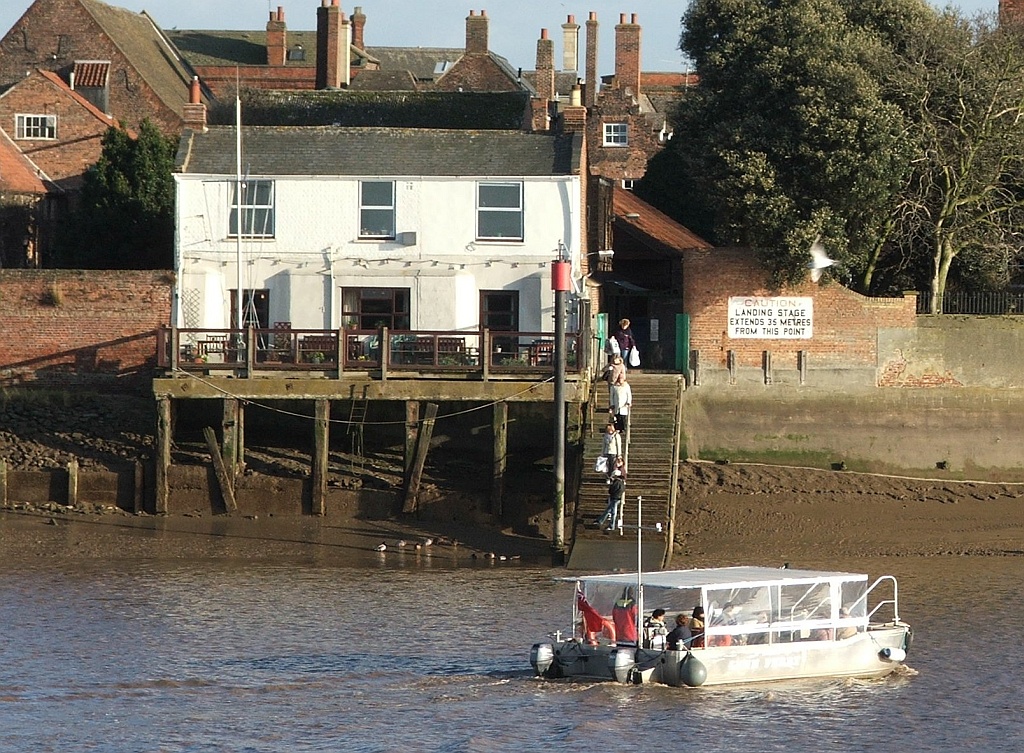
My proposed caption for this image was "Passengers descend the steps at the Ferry Lane jetty on the Lynn side of the river as Steve and Gail's new ferry boat approaches". I recall that what is now the Ferry Lane Social Club was a popular pub, especially in the summer, but at a hundred yards down a pedestrian alley you had to be a local to know it was there.
It's low tide and the ferry boat arrives at the very end of the West Lynn jetty and the Cawthornes make their way down the steps to get on board. I have arranged to talk about the ferry with Steve and Gail Kingston and follow them into their office. This is at one end of the pavilion. At the other end are public conveniences, useful both for ferry passengers and for those finishing their trek up the Fen Rivers Way, the long distance footpath that follows the Cam and Great Ouse all the way from Cambridge.
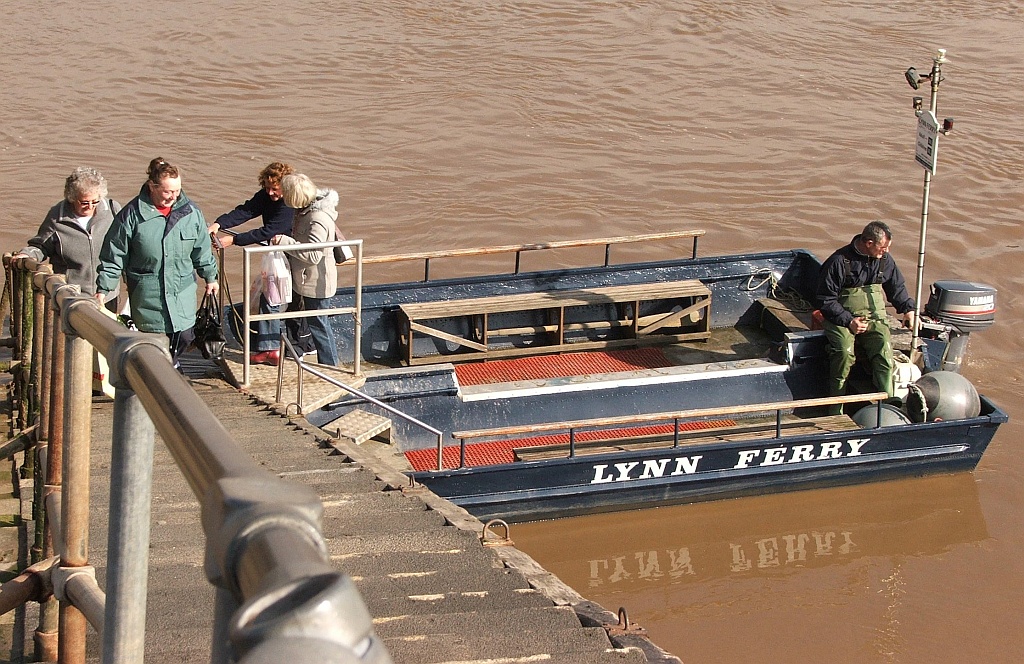
Gail Kingston helps a passenger ashore at West Lynn from the old "low water boat".
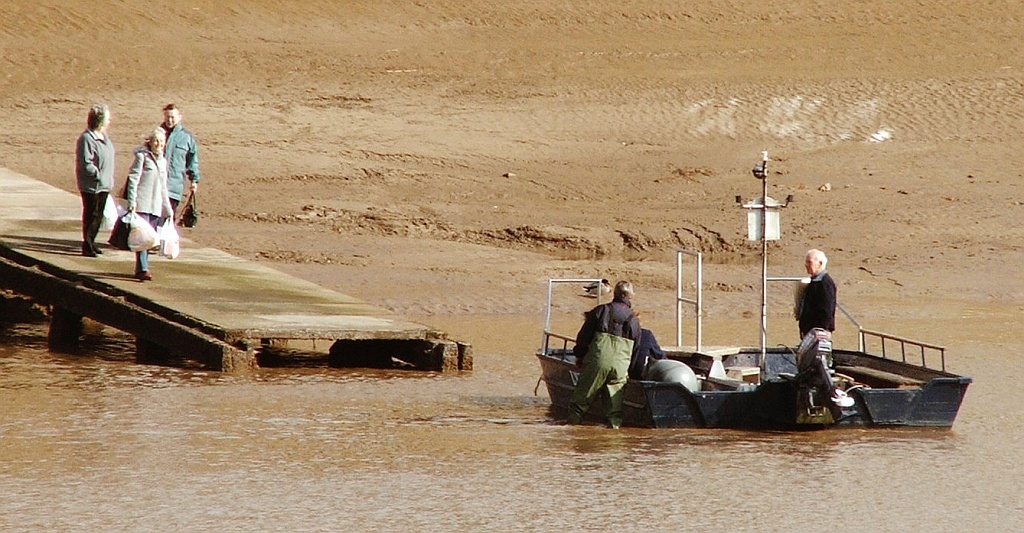
With the old low water ferry Steve Kingston still needs to jump overboard and push the boat ashore.
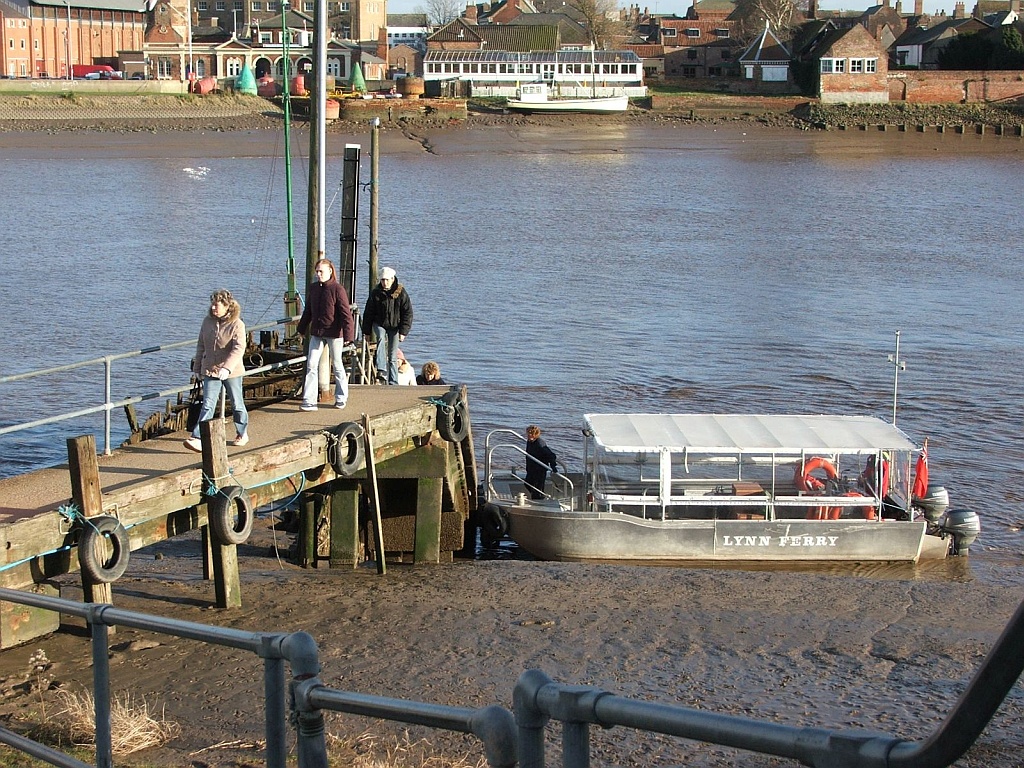
Another of the pictures not used by the magazine showing passengers disembarking at West Lynn.
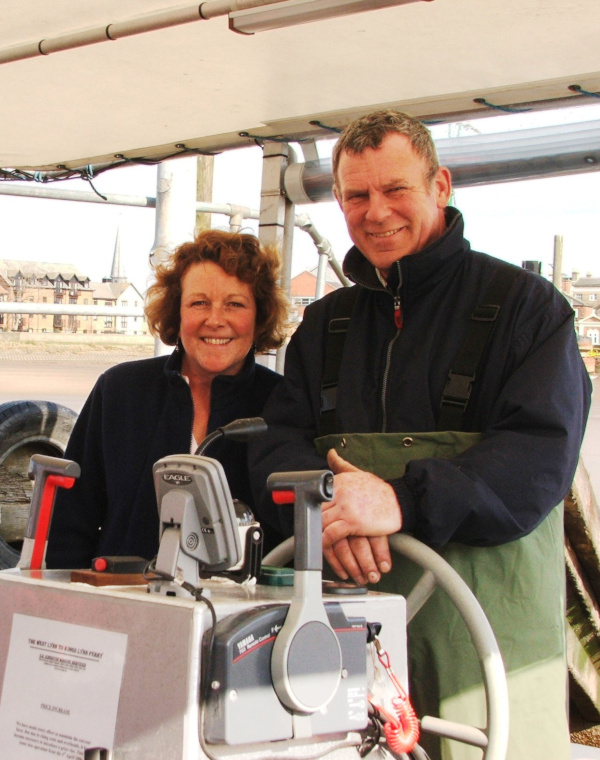
Steve and Gail Kingston, the ferry operators since 1 May 2000. Proud of the service they offer, they see a long future for the ferry.
Steve and Gail, who took over running the ferry on 1 May 2000, have a few minutes in which to grab a mug of coffee before they set off across the river again. "Who's the boss?" I ask. "Who should I speak to?" With a wave of his hand, Steve indicates Gail. I start by asking how life running the ferry works. "Steve is up every day at five o'clock. He has to sweep the silt from the steps to make it safe for passengers before the first official crossing at seven o' clock", says Gail. Steve adds, "Several regulars start work at seven, and we normally manage an early trip to make sure they get to work on time, before the first scheduled trip". They live only a few minutes walk from the jetty. As it is, It won't be till after seven at night that Steve will be home from work - and it's a six day a week job!
Although, initially, reluctant to talk, Steve is now into his stride. "It's never the same journey twice." he says. "Not only does wind and tide affect the route taken but there are constantly changing sandbanks, too." I was surprised at this, as I had assumed that this powerful river, with its 27 foot tidal range, would have scoured an adequate channel for itself. Steve explained, "Before we ran the ferry the Washport Bunkering Service had the licence. They used two different boats for the service. One of these was bought especially to counter the problems of grounding at low water". Later I was shown press cuttings which showed that, once, passengers had been forced to paddle ashore, or been given a piggy-back, when the boat had grounded. On another occasion planks had to be laid across the tops of beer crates, to get passengers to the jetty at an exceptionally low tide.
"We spent two or three years experimenting", said Steve, explaining how they had endeavoured to overcome this problem. "At one time, we had two ex-army assault craft coupled together. We wanted to get the right design, that offered stability and comfort for the passengers, and could cope with both low and high water conditions. Last year we spent £30,000 on the purpose-built aluminium boat built that we use now."
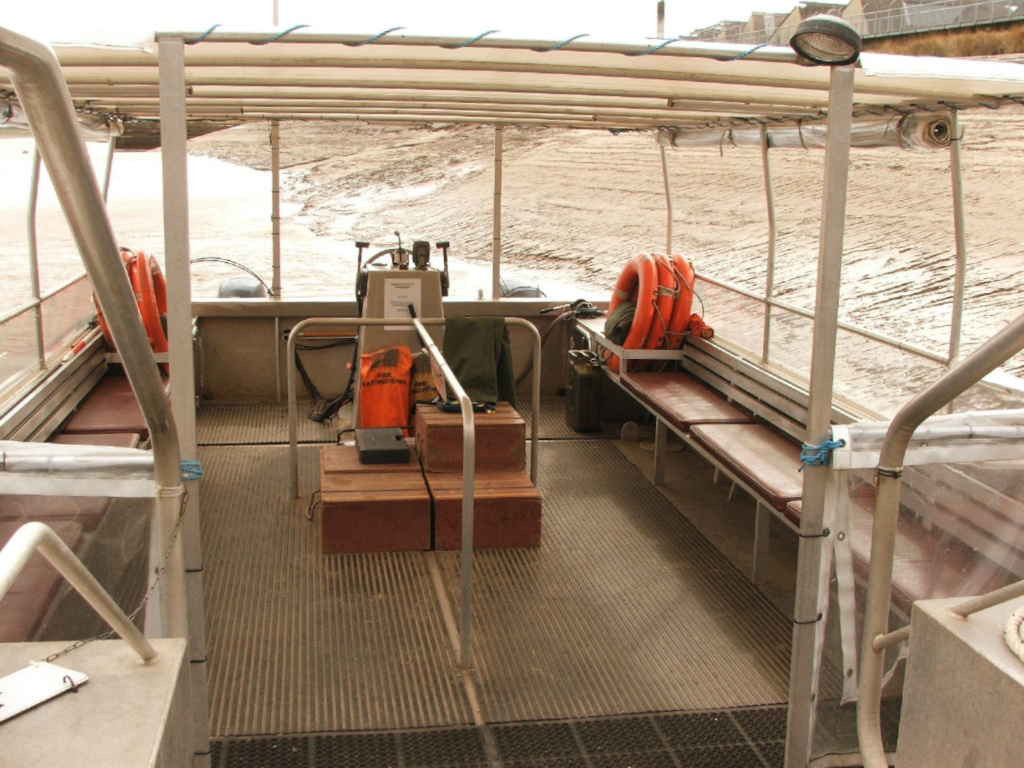
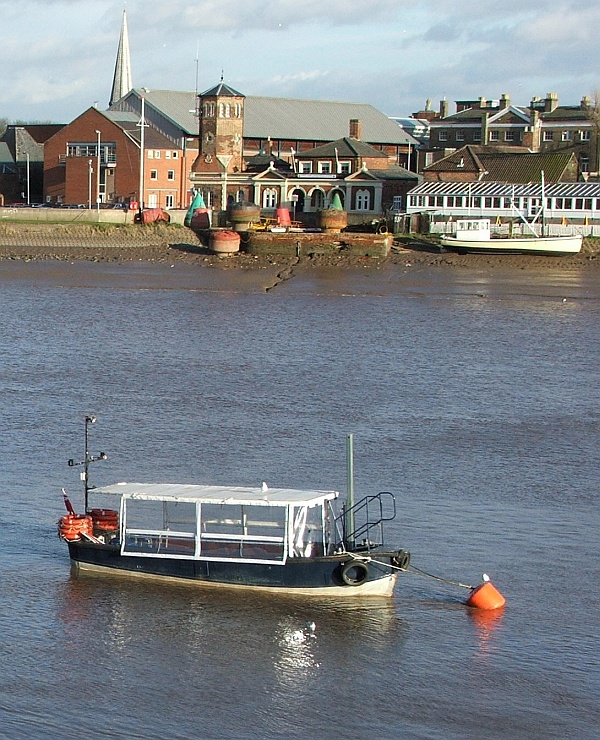
This boat is powered by twin 30hp Yamaha engines. These have independent controls so that one can be made to run forward while the other goes astern, allowing the boat to spin virtually in its own length. It offers better seating than earlier boats and protection from the worst of the weather, with roll-down plastic screens. The new boat even has fluorescent lighting to make boarding and disembarking safer on winter evening.crossings.
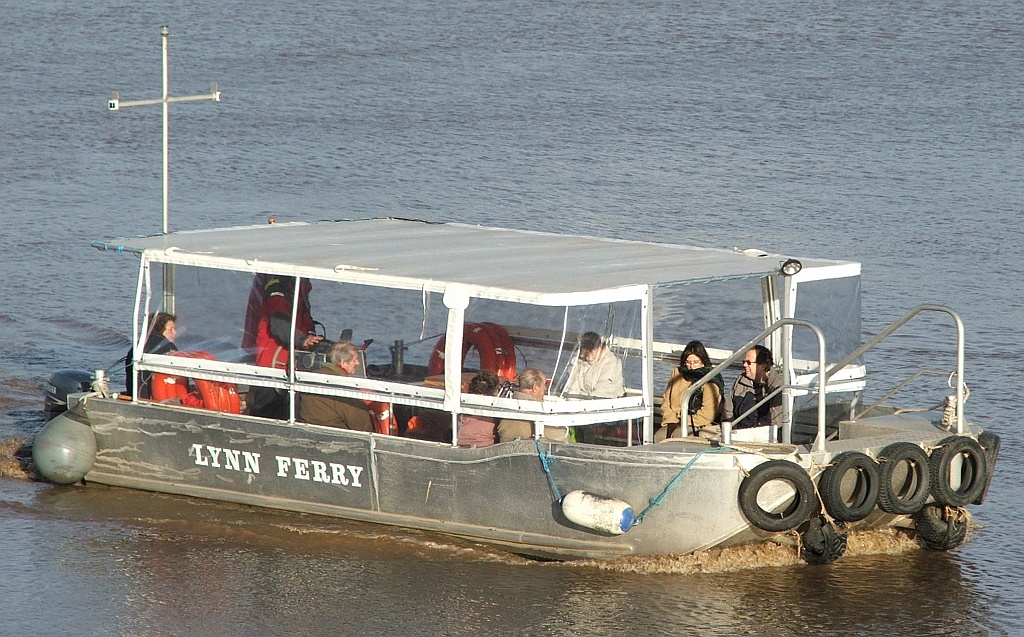
My proposed caption for this image was: "The new ferry boat on a cold but bright January afternoon crossing from West Lynn".
The new purpose-built aluminium ferry boat offers more comfort for passengers and can cope with all but the most extreme conditions.
It certainly wasn't like that in days gone by. Records show that there was a Lynn Ferry already working before the end of the thirteenth century. Until the building of the new Freebridge in 1821, travellers wanting to cross the river would have had to travel to Wiggenhall St Germans and cross the bridge there, if the ferry was out of service. Some would have thought that the new bridge would put an end to the ferry, but using that route still entailed a four mile journey from West Lynn to the centre of town. As recently as the 1920s the ferry was still rowed. It was then that fares were doubled to one (old) penny, when a petrol engined boat was introduced. There were near riots and a policeman had to be stationed at the jetty steps in Ferry Lane.
One of the old ferry boats, suitable only for use at high tides, is still held in reserve. In the background is the old Victorian Conservancy Board and Pilot's offices.
By the fourteen century the rights to provide the ferry service was in the hands of the powerful Trinity Guild of local merchants. It wasn't until 1649 that the corporation took over the rights. In 1973 the rights were passed to Norfolk County Council. The Council paid for the upkeep and maintenance of the ferry boats and subsidised the fares. An operator paid for the petrol, but was struggling to maintain a service.
The problem is that the rights also confer an absolute duty to provide the ferry service. By 1989, the Council sought either a Private Members Bill to enable closure, or an independent commercial operator to run a full commercial service. At this point the marvellously named Washports Bunkering Service Ltd took over. They introduced Sunday tourist trips for the first time, in an effort to make the service viable. (Bunkering services is the term for liquid supplies to ships, e.g. water and oil, as distinct from Victualling services, the supply of food.). However, by 2000, they too had decided not to re-apply when the licence came up for renewal.
That's when the Kingstons made their bid. Since they took over they have seen passenger numbers grow from 24,000 in their first year to 80,000 in 2005. They are proud of what they have achieved and put part of the success down to it being their own business. "We have been determined to make the service reliable", said Gail. "This was difficult with the boats we inherited from the Washport Bunkering Service. We like to feel that people have come to rely on us to get them across whatever the weather or state of the tide. That didn't always happen in the past." Gail did admit that having the new waiting room had helped as well.
My last question was about the future. The town's NORA (Nar Ouse Regeneration Area) scheme, and other millennium projects, had meant a great deal of money was being spent on the town, including the waterfront. There is even talk of a new footbridge to be built to West Lynn. Did they see that as a threat to the ferry? How did they see the future? "Have you read those reports? The bridge is pie in the sky", snorted Steve. "It was obviously dreamt up by someone who doesn't understand the river and how it would affect the new marina". It was clear that they saw a continuing need for the service they provide for many years to come.
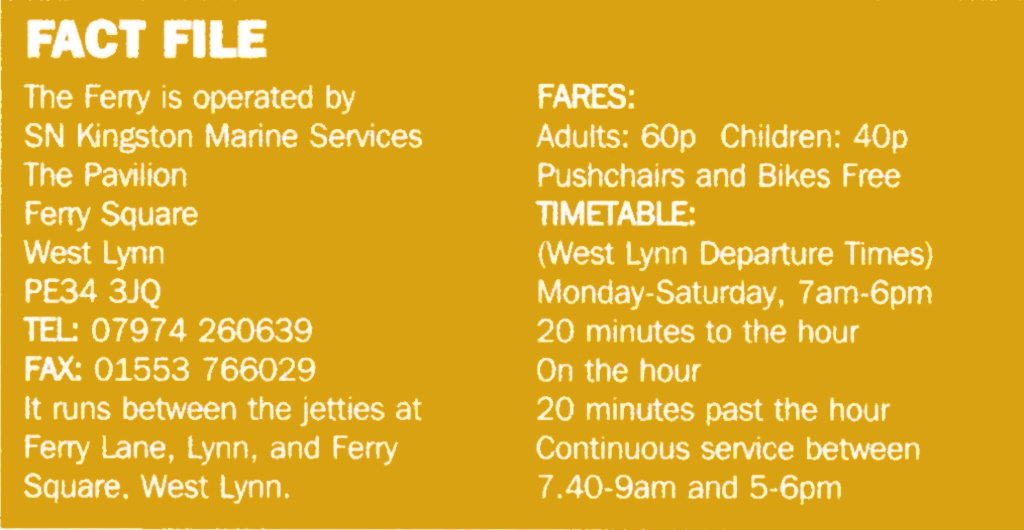
As the magazine's articles often included small panels with information pertinent to the accompanying article I thought it best to produce something similar for my submissions. This is the one that appeared in the magazine for the Lynn Ferry.